Dunlop composite wheels &
maintenance
The Dunlop composite wheel, with an alloy centre with 10
trapezoidal holes and a chromed steel rim, is a particularly strong
wheel and in the 1970s it was the type of feature you would have more
likely be seen on exotic sports cars. Dunlop advertised them as their
"Formula D4 alloy/steel composite wheel” to “give your
car real personality!” MG chose these distinctive wheels for
their new V8 powered MGBGT model launched in August 1973.
Dunlop's Formula D4 information
Dunlop composite wheels
See
our two page article
Personal preference for a salvage procedure
Jim Livingstone concludes in his contribution to the two page article
on this topic that "I have no doubt that the composite wheels
met their original performance requirements; I am much less confident
that a restorer with limited facilities could reproduce those standards
after dismantling and rebuilding a wheel that has been in service
for many years. For that reason, my preferred salvage approach would
be to avoid disassembly wherever the centre-to-rim joint remains secure
and both components are serviceable. This obviously rules out re-chroming
the rim and will not satisfy those seeking absolute originality.
On a positive note, if the wheels are structurally sound, I would
recommend abrasive blasting and repainting with a modern chrome lookalike
finish. If the wheels are not suitable for that restoration and funds
permit, Clive Wheatley's 15-inch all-alloy lookalike reproductions
would be my preferred alternative.
In conclusion, my design analysis is partly confounded by the evidence
of a significant number of original Dunlop composite wheels which
have survived fifty years of service. In my defence, I would maintain
that this is the triumph of diligent maintenance by V8 owners over
an inherent weakness in the design".
Posted: 250814 |
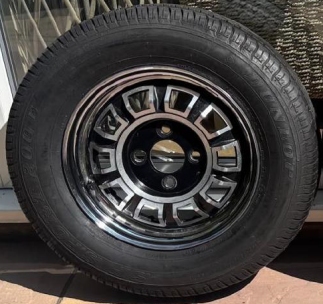
Dunlop
composite wheels were a distinctive original feature of the
MGBGTV8 which Dunlop said "gives you car real personality"
Restoration
service options available
Since the withdrawal of the full Dunlop composite restoration
service by Motor Wheel Services (MWS) in 2016 what refurbishment,
restoration or other options have been available?
Solent Wheels have offered a refurbishment service for
Dunlop composites which does not involve splitting the rim and
alloy centre but instead grit blasting the wheel to bare metal
to remove corrosion from the chromed steel rim, then repairing
any kerb damage, filling any areas where corrosion has been
removed and applying the self-etching primer which is baked
in a low bake oven, then the wheels are flattened down to create
a smooth surface. The wheels are top coated and lacquered with
a durable Polyurethane silver coloured paint and clear coat.
The result is a smooth, polished finish which is durable, lasting
for many years. These refurbished wheels can only be distinguished
from the original chromed rims from a close inspection. It's
not an original chrome finish but it looks very good and is
good value for money. Link
Renowheel offer a Dunlop composite wheel
restoration service which involves splitting the wheels (marking
each one so they can go back together exactly as they come apart),
removing corrosion and rechroming the steel rims, refurbishing
the alloy centres and then reassembling and balancing each wheel.
It's a skilled and costly restoration process to maintain the
original design and appearance of Dunlop composite wheels. Link
All-alloy replacement wheels
They are an alternative to a refurbishment or restoration of
the original Dunlop composite wheels.
All-alloy
lookalike wheel - Clive Wheatley mgv8parts offers all-alloy
lookalike wheels which are very good value too. They are a slightly
larger diameter (15” rather than the original 14”)
and they need a different tyre size to maintain a near identical
speedometer reading. They have been an acceptable option for
many owners of MGBGTV8 and MGBV8 conversions. Link
Minilite wheels were originally designed for racing and
rallying, their good looks ensured that they were soon seen
on road cars as well. Today they are available for use on a
wide range of historic and classic cars - the Minilite style
is never out of fashion. Link |
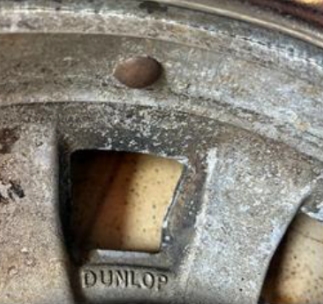
Cast
aluminium centre is riveted to a rolled steel rim with steel
rivets which create a galvanic corrosion risk
Corrosion
issues with Dunlop composites
MGBGTV8 owners have found that over time the recess, where the
inner edge of the chromed steel rim is attached to the alloy
centre, on original Dunlop composite wheels can attract rust.
If it's not controlled with regular cleaning and polishing or
using a water dispersant like WD40, corrosion can develop to
an extent the wheels reach a sad state and need refurbishment.
The combination of iron and aluminium creates a galvanic corrosion
risk,
particularly in the hostile environment experienced by a road
wheel.
Galvanic
reaction
Overview
of Dunlop composite wheels and their maintenance
For a roadwheel designer in the late sixties the prospect of
combining the impact advantages of a steel rim with the rigidity
and weight saving properties of a cast aluminium centre must
have been irresistible. In Dunlop’s case they produced
their Formula D4 alloy/steel wheel which was adopted by MG for
their MGBGTV8.
From a twenty-first century perspective, the composite wheel
is something of a compromise, offering relatively few advantages
over single-material alternatives while introducing some disadvantages
of its own including:
Joint geometry. The fit at the interface between rim
and centre is critical to load transference. Any loss of clamp
force can cause fretting from cyclic loading. The presence of
ten rivets also introduces a risk of air loss.
Dissimilar materials. The combination of iron and aluminium
creates a galvanic corrosion risk for a road wheel.
The specialist wheel restorer MWS withdrew their Dunlop composite
restoration service in 2016 because the restoration work had
become very difficult. Reassembling the wheels with new rivets
and carefully balancing each wheel could take up several hours
so the costs became a serious burden. So over the years the
practical issues with bi-metal galvanic corrosion weakness and
the complexities and cost of the restoration of the wheels have
become a greater concern.
Options with corrosion on Dunlop composite
wheels
See our webpage with a note and an options chart. Notes
& Chart
|
|


